How it works Why builders trust it Status Log in Request a demo
The design-to-permit platform for semi-custom builders

From base plan to a sealed permit set — in one sitting, not one quarter.

BuildLoop unifies the work between a base plan and a permit. Configure a customer's job with live pricing, pre-size the structure, hand off to your engineer of record to seal, and assemble a submittable set — so you stop losing months to redesign, without ever faking a number.

Estimates stay estimates until the engineer signs
Your engineer of record seals
A record no one can quietly edit
BuildLoop · builder workspace · Configure
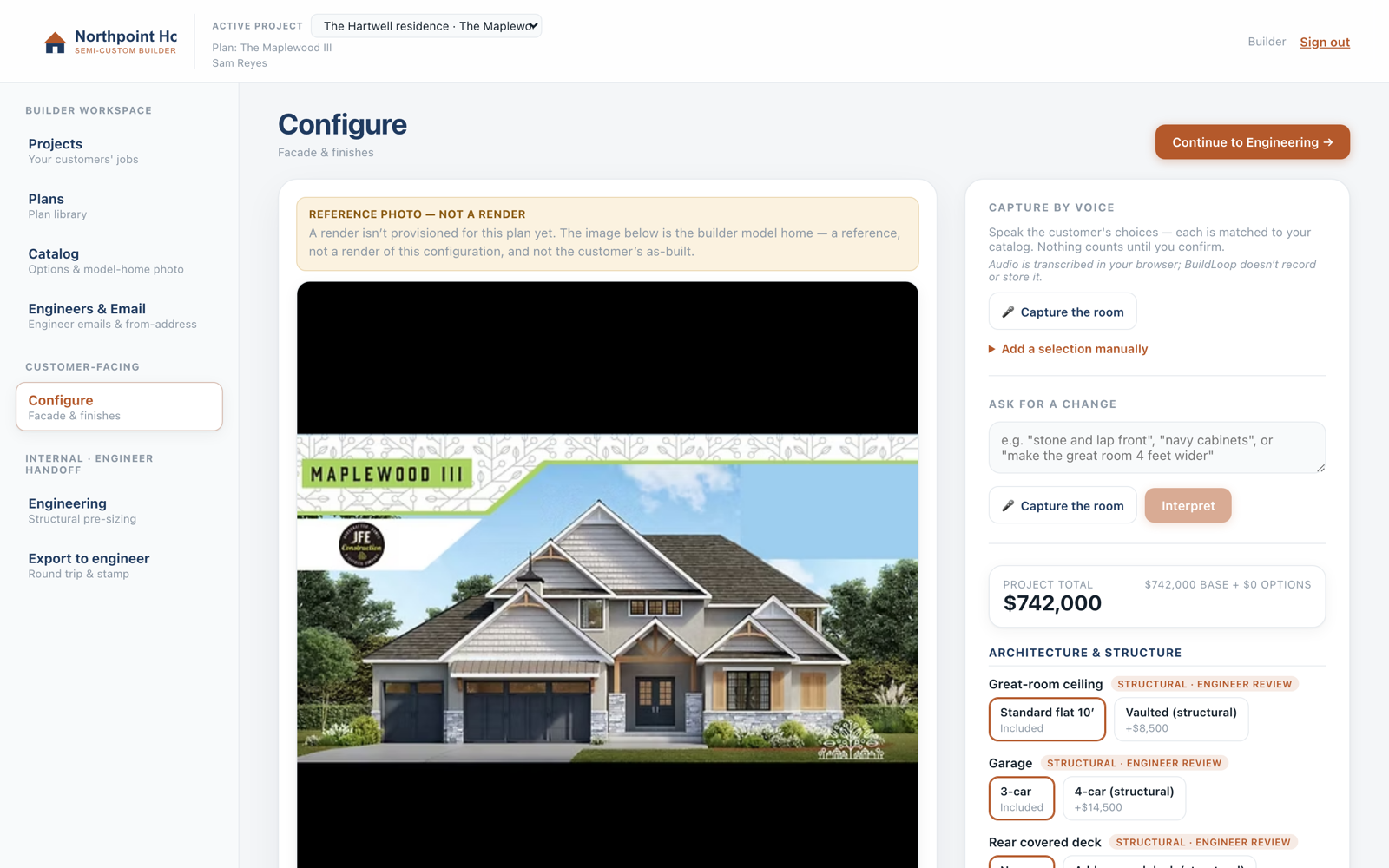
The BuildLoop configurator: facade and finish selection with live pricing and structural-review flags
An actual BuildLoop screen — not a mockup · demo data, names anonymized
1–4 mo
of upstream redesign BuildLoop is built to compress
7–10 days
Johnson County residential permit turnaround — the city isn't the bottleneck
290
automated backend tests, CI-green on every change
100%
of permit-set output engineer-sealed — nothing leaves the loop unsealed
Built for
Semi-custom home builders
Base-plan catalogs
Engineers of record (P.E.)
Permit-driven jurisdictions
Kansas City metro · MO & KS
One project record

Every customer change, price update, hand-off, and stamp traces back to one project record — logged as it happens, locked once it's written. Your team does the standard work; the stamped call stays with your engineer.

How the loop closes

From a sentence to a sealed permit set.

Describe the change in plain language. BuildLoop turns the words into parameters, does the standard, deterministic work, and hands the licensed judgment to your engineer of record — the model file round-trips, the seal comes back.

STEP 1

Describe & confirm

"Wider great room, swap the rooms, new facade" — typed or spoken. AI turns the words into parameters; the builder confirms.

STEP 2

Standard work

BuildLoop applies the facade and finish selections and flags the structural items for your engineer of record.

STEP 3

Engineer round trip

The model file goes to the engineer's own CAD tool — roofline, load path — and back. They review and stamp.

STEP 4

Sealed to city

The sealed permit set — PDF + DWG — ready to submit.

Not a CAD tool

We never build the drawing canvas. Heavy structural editing happens in the engineer's own tool — the result flows back as the model file. A browser-based CAD/BIM canvas is explicitly out of bounds.

Describe the change. We turn words into parameters.

"Make the great room wider. Swap the office and the third bedroom. Stone-and-lap front instead of stucco." Typed or spoken — BuildLoop interprets each request against your editable catalog and asks you to confirm, with the price delta, before anything is applied.

  • AI turns plain language into structured parameters
  • Mandatory confirm, with the live price delta
  • Structural-affecting picks flagged for the engineer — never silently changed
BuildLoop · Configure — facade & finishes
BuildLoop configurator with live pricing, voice/text change capture, and structural-engineer-review flags
Actual BuildLoop screen — builder workspace

BuildLoop does the standard work — and flags the structural.

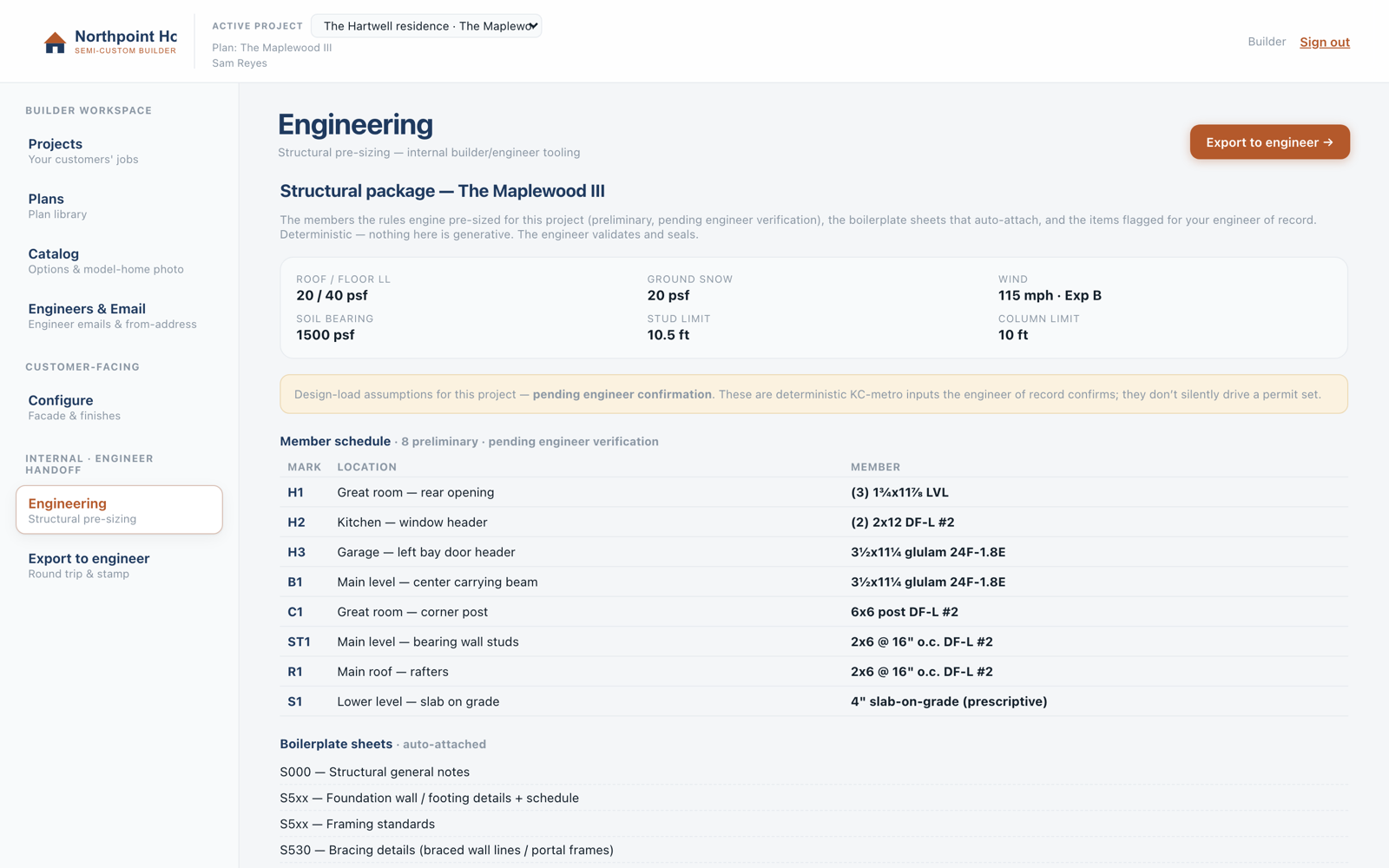
BuildLoop handles the standard, by-the-book work and pre-sizes the structure against the IRC tables and Kansas City metro loading numbers — then flags everything that needs an engineer's call: rooflines, load paths, anything outside the tables. It's all labeled preliminary until your engineer verifies it — no guessed numbers, no AI-generated structure.

  • Member schedule with design loads and envelope limits
  • Out-of-envelope items flagged for the engineer of record
  • Boilerplate sheets (notes, foundation, framing, bracing) auto-attached
BuildLoop · Engineering — structural pre-sizing
BuildLoop preliminary structural package: member schedule, design loads, and auto-attached boilerplate sheets, labeled pending engineer verification
Actual BuildLoop screen — preliminary structural package

Hand off the model file. The engineer fixes the rest.

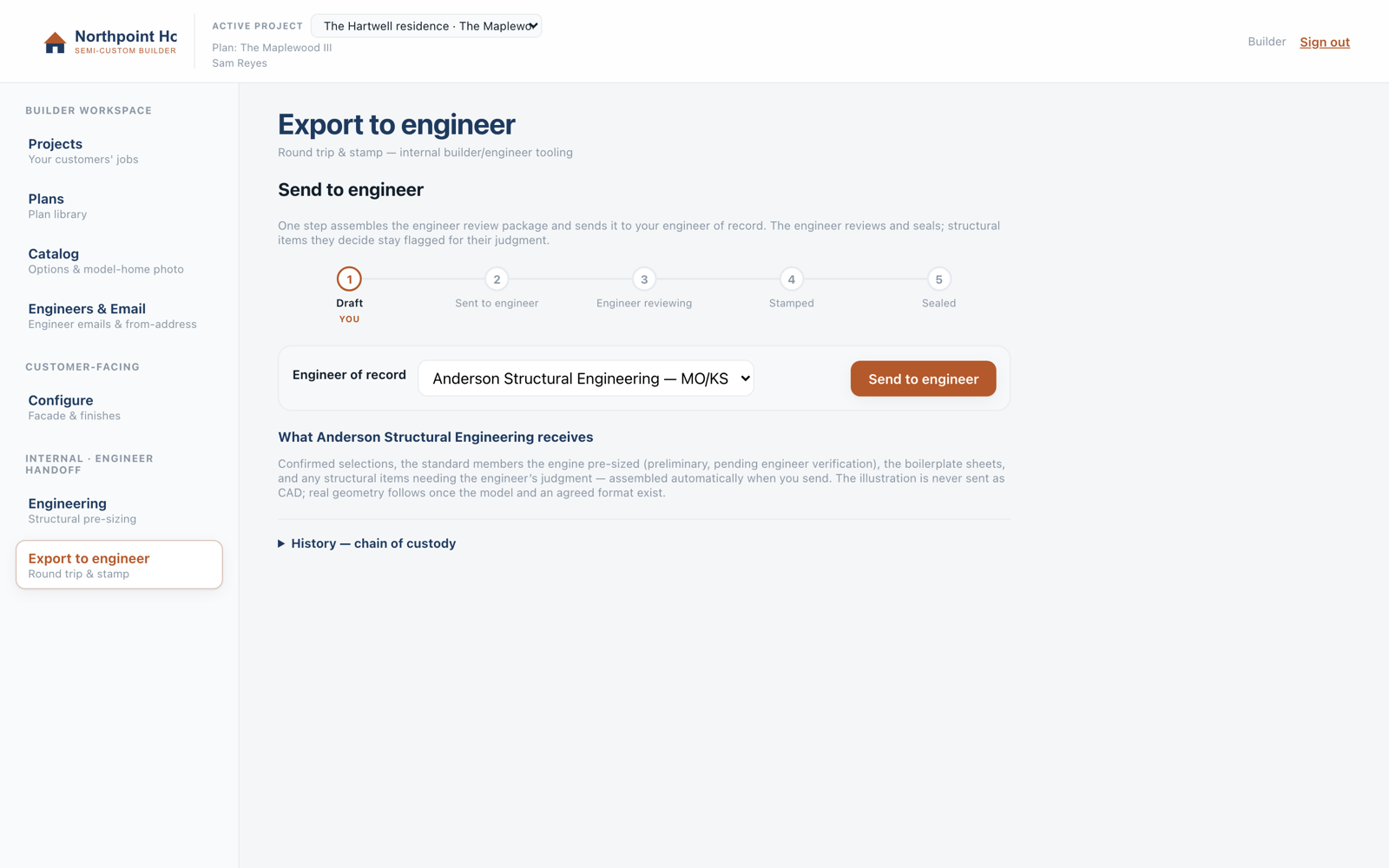
BuildLoop exports the model file to your engineer of record. They open it in their own CAD tool, resolve the roofline and the load path, and send the model file back — which BuildLoop ingests. We never build the drawing canvas; heavy structural editing stays where the license is.

  • Round trip via the model file — out to the engineer, back into BuildLoop
  • The engineer's own CAD tool — roofline, load path
  • Explicit status stepper: Draft → Sent → Reviewing → Stamped → Sealed
BuildLoop · Export to engineer — round trip & stamp
BuildLoop engineer hand-off: status stepper from Draft to Sealed, engineer-of-record assignment, and the project history log
Actual BuildLoop screen — engineer hand-off & round trip

Review, stamp, and a sealed set to the city.

Back in BuildLoop, the engineer reviews and stamps. The sealed permit set — PDF + DWG — is the locked, submittable deliverable, ready for the city. There's no path for a builder to mark a set "Sealed" — the system blocks it, and tests keep it that way.

  • The engineer reviews and stamps inside BuildLoop
  • Sealed set = PDF + DWG, ready to submit to the city
  • Locked once sealed — a correction is a new version, never an overwrite
BuildLoop · Export to engineer — sealed deliverable
BuildLoop sealed deliverable: sealed by the engineer of record, with a download for the submittable permit set
Actual BuildLoop screen — sealed deliverable
On the record, by design

A paper trail that holds up.

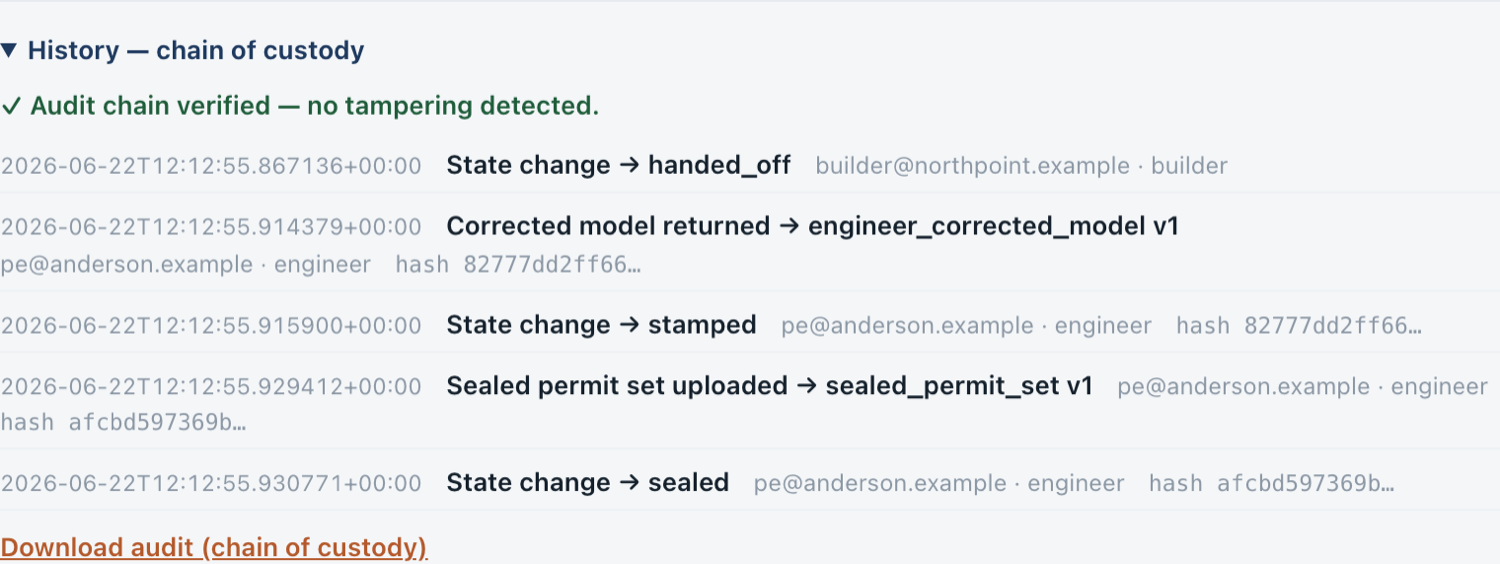
Every step and every file is logged with who did it, their role, and when — and the log can't be quietly edited after the fact. If the city, an insurer, or a lawyer ever asks, you export the project history and hand it over.

BuildLoop · project — history log
BuildLoop project history log, verified: each status change and file event with who did it, their role, and when
Actual BuildLoop screen — per-project audit trail, chain-verified
Why builders trust it

Speed an inspector — and a court — can trust.

BuildLoop runs on one rule: it never shows you a number it didn't earn. Nothing gets dressed up as final before it is.

Your catalog, your prices
Plain-language changes turn into real options from your own catalog — never an invented finish or a made-up price. Structural requests get flagged for your engineer, compound requests get split, and anything unclear comes back as a question with the closest real options.
No faked numbers
Estimates are labeled estimates. The seal is a licensed act only your engineer performs. A model-home photo is never passed off as the customer's house. If something isn't ready, BuildLoop says so — it never fakes it.
Everything on the record
Every status change and file event is logged with who, what role, and when — and the log locks as it's written, so any edit, deletion, or reshuffle shows. Export a project's full history to JSON or CSV any time.
Roles you can't shortcut
Enforced by the system, not the honor system: a builder can't stamp their own plans — blocked outright, and test-locked to stay that way. Design loads are entered and confirmed by the engineer, with their name and timestamp attached — never a silent app default.
Ready for the next builder
Each builder gets isolated data, their own catalog, engineers, and branding — separated at the data layer. Bringing on the next builder is a setup task, not a rebuild.
Runs lean, scales up
Runs as a local pilot today. Every outside service — database, storage, email, AI — sits behind a switch, so moving to the cloud is a configuration change, not a rewrite.
Where it stands

The pilot is open. We're looking for builders.

The full loop runs today, and it's free for pilot builders while we shape it around real jobs.

Working today
  • Describe a change in plain language — see it configured with the live price delta.
  • Structure pre-sized, with everything that needs an engineer's call flagged.
  • Hand-off to your engineer of record, stamp, and a sealed permit set — PDF + DWG.
  • Every step logged on one project record you can export.
The pilot
  • For semi-custom builders and their engineers of record in the Kansas City metro.
  • Free during the pilot — no license fee, no long contract.
  • You work directly with the team; what gets built next comes from your jobs.
Request a pilot demo

See the loop run end-to-end.

For semi-custom builders and engineers of record in the Kansas City metro. Tell us a little about your work and we'll set up a walkthrough.

Prefer email? Write to [email protected] directly.